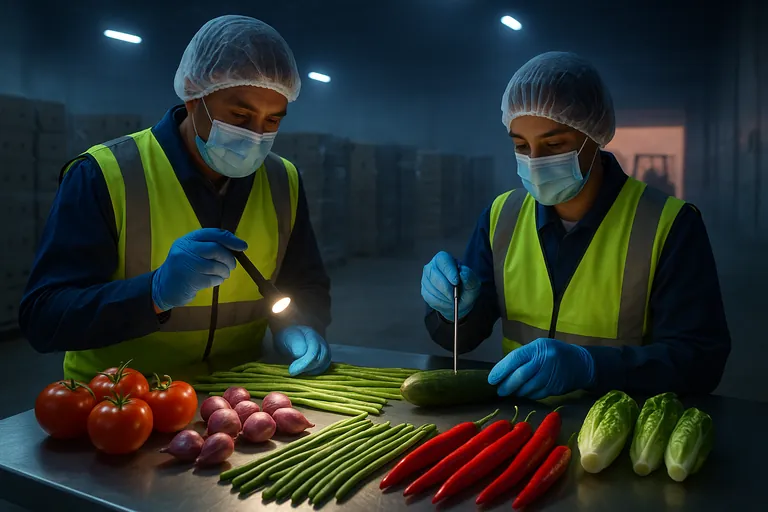
A practical, field-tested MRL audit checklist for Indonesian vegetable suppliers targeting 2025 EU compliance. What to review before you buy, how to verify PHI on-farm, the right sampling plan, lab selection, pass/fail thresholds, and what to do if results go wrong.
If you buy vegetables from Indonesia for the EU, you already know this reality. One residue result can make or break a season. We’ve spent years building suppliers that pass without drama. Below is the exact MRL audit checklist we use. It’s practical, sometimes blunt, and it works.
Why an MRL audit matters more in 2025
EU authorities continue to tighten oversight and lower MRLs for non‑approved actives to the default 0.01 mg/kg. Retailers are pushing internal limits even lower to protect brand risk. Indonesia’s climate makes pest pressure real, so spray decisions can get reactive. That’s why an evidence‑based audit system is non‑negotiable. Do this once, properly, and you’ll sleep better before every shipment.
The three pillars of MRL assurance
- Control what goes on the crop. 2) Prove traceability from farm block to pallet label. 3) Verify with a risk‑based sampling plan and accredited testing. When one pillar is weak, the whole program wobbles.
What documents should I request to prove MRL compliance?
Ask for these before you commit volume. If any of them are “in progress,” slow down.
- Master crop protection policy. Includes banned and restricted pesticide list aligned to EU approvals. The supplier signs that list.
- Season plan by crop and farm block. Expected actives per pest and pre-harvest intervals (PHIs) per active.
- Farm maps with block IDs and planting/harvest windows. GPS or simple grid maps both work, as long as blocks are unique.
- Spray records. Date, time, active and brand, dose, spray volume, water pH, operator name, and weather conditions.
- Pesticide purchase and stock ledgers. Match what’s sprayed to what’s bought.
- Training records. Applicators trained in PHI, label use, and nozzle calibration within the last 12 months.
- Equipment calibration logs. Knapsack or boom sprayers checked every 3 months.
- Pre-shipment Certificate of Analysis template and history. Multi-residue scope, LOQs, reference to EU Reg 396/2005 MRLs.
- Traceability SOP. How harvest bins become cartons and pallets, and how labels link back to block and harvest date.
Practical takeaway. If you only check two things, check the banned list acknowledgement and the actual spray records against harvest dates. That catches most problems early.
Which Indonesian vegetables are highest risk for EU MRL exceedances?
From our own files and EU notifications, the higher‑risk bucket includes hot chilies, long beans, okra, leafy greens, cucumbers, and eggplant. In our range, watch Red Cayenne Pepper, Japanese Cucumber (Kyuri), Purple Eggplant, Baby Romaine (Baby Romaine Lettuce), and Loloroso (Red Lettuce). Medium‑risk includes Tomatoes. Lower‑risk tends to be root and bulb crops like Carrots (Fresh Export Grade) and Onion, but don’t skip verification.
What’s interesting is that risk changes by season and region. We’ve seen leafy crops test clean for months, then spike when pest pressure rises with weather shifts. Build monitoring that adapts.
How do I verify spray records and PHI on-site?
Here’s the on-farm audit flow our team uses:
- Walk the blocks you’ll actually buy from. Confirm block IDs match the map and the harvest calendar.
- Pick a recent shipment. Pull the spray sheets for that block for the prior 60 days. Cross‑check actives used against the banned list and EU approvals.
- Recalculate PHI. Count days from last application of each active to harvest date. We like to see a simple one-page PHI matrix posted in the farm office and packhouse.
- Match sprays to stock. Compare the ledger of purchased pesticides to the brand names on spray sheets. If the brand doesn’t appear in purchases, ask why.
- Interview applicators. Ask how they measure dose, check water pH, and clean equipment. Unannounced questions reveal real practices.
- Look for drift risk. Neighboring crops and shared sprayers can derail you even if your block is clean. We’ve caught residues that traced back to a neighboring farmer’s chlorpyrifos years ago.
Two non‑obvious checks that save shipments. Verify water pH at mixing. Too acidic or alkaline can change residue persistence. And check the actual measuring tools. Dosing cups and scales tell you more truth than a polished SOP.
Packhouse and traceability audit
- Harvest bins labeled with block ID, harvest date, and picker code.
- Intake log that records bin labels against incoming weight and assigns a unique lot code.
- Segregation controls. Physical or time-based separation by lot through washing, grading, and packing.
- Pallet labels that carry the lot code, pack date, and customer reference. Can you trace one retail carton to the exact farm block within two minutes? That’s our standard.
For frozen lines like Premium Frozen Edamame, Frozen Mixed Vegetables, and Frozen Paprika (Bell Peppers) - Red, Yellow, Green & Mixed, verify both raw material traceability and finished product lot composition. Compositing across farms without controls is where problems hide.
How often should I test and how many samples per lot?
We use a risk-based matrix that buyers can implement immediately.
- New suppliers or new fields. Test every lot for the first 5 lots. If clean, step down per risk.
- High‑risk crops. Test 100% of lots at season start for 4 to 6 weeks. If all clear, move to 1 in 3 lots. If any detection above action limits, revert to 100% for 4 lots.
- Medium‑risk crops. 1 in 3 lots, then monthly if performance is clean.
- Low‑risk crops. 1 in 5 lots or at least monthly, whichever is more frequent.
Composite sampling per lot. Collect a minimum of 1 kg lab sample composed of at least 10 primary units spread across the lot and time of packing. Keep a duplicate 1 kg retention sample sealed at 0 to 4°C for 14 days. For small items like chilies or cherry tomatoes, 1.5 kg total sample weight gives the lab enough material for confirmation.
Pre-harvest testing. For high‑risk crops, add a pre-harvest test 7 to 10 days before expected harvest from each block. It’s cheaper than a rejected container.
Need help building a crop-specific plan for your program? Contact us on whatsapp.
Do I need an ISO/IEC 17025 lab in Indonesia or at destination?
Both can work. Our rule of thumb:
- Use an ISO/IEC 17025 accredited lab in Indonesia for pre-harvest and pre-shipment screening. Confirm LC‑MS/MS and GC‑MS/MS multi‑residue scope of 300+ actives and LOQs at or below 0.01 mg/kg.
- Use a destination-country accredited lab for retailer acceptance testing when the retailer requires it or when a result is borderline and you need a second opinion.
Always have the lab report reference EU 396/2005 with MRLs for the tested commodity and include measurement uncertainty. If a lab can’t state uncertainty, they’re not ready for your business.
What internal action limits should I use below the EU MRL?
We recommend conservative thresholds that account for measurement uncertainty and retailer policies.
- High‑risk crops. 50% of EU MRL as the internal action limit. Anything above triggers a hold and a review.
- Medium‑risk crops. 70% of EU MRL.
- Low‑risk crops. 80% of EU MRL.
- Non‑approved substances in the EU. Treat as zero tolerance at the LOQ. Any quantified detection is a fail.
This approach keeps you out of trouble when lab results vary by a few hundredths due to matrix effects.
Pre-shipment COA requirements that avoid headaches
- Single lot per COA. Do not mix.
- Commodity-specific MRL reference, not a generic fruit/veg table.
- Report at least the top risk actives for the crop. For chilies, ensure coverage of acetamiprid, cypermethrin, lambda‑cyhalothrin, carbendazim legacy checks, and others flagged in recent EU alerts.
- Include sample date, sampling method, lab LOQ, and uncertainty.
Corrective action plan when a shipment exceeds the MRL
A solid plan shortens disruption from weeks to days.
- Containment. Freeze the lot and all linked pallets. Inform customers of the hold.
- Confirmatory test. Use a second ISO 17025 lab on the retention sample within 24 to 48 hours.
- Root cause. Run a 5 Whys session with the farm and packhouse. Was it PHI, spray drift, mislabelled product, or a misread dosage?
- Fixes. Retrain applicators, recalibrate sprayers, adjust PHIs, and update the banned list if a new risk appears. Add 100% lot testing for the next 4 to 6 lots.
- Documentation. Write a one-page CAPA with owner, deadlines, and verification evidence. Share it with buyers. Transparency rebuilds trust faster than promises.
Common mistakes we still see
- Assuming “GlobalG.A.P. certified” equals clean residues. It helps, but it’s not a guarantee.
- Skipping duplicate retention samples. When a result surprises you, that second bag is gold.
- Forgetting neighboring farm drift. Buffer zones and spray windows matter.
- Not adjusting test frequency when weather changes pest pressure. Static plans cause dynamic problems.
Pass/fail criteria your team can apply consistently
- Pass. All residues below internal action limits and no non‑approved actives detected above LOQ.
- Conditional pass. Residues between action limit and MRL. Ship only with buyer approval and immediate corrective actions.
- Fail. Any residue above MRL or any non‑approved active detected above LOQ. Hold, investigate, and retest.
Where this advice applies, and where it doesn’t
This checklist is built for fresh and frozen vegetables exported from Indonesia into the EU. It focuses on crop protection and residues, not sizing, defects, social compliance, or pricing. For other markets like the UK or Middle East, the structure holds, but action limits and target actives may change.
Final takeaways you can use today
- Get the banned list signed and the PHI matrix posted. That single act cuts your risk in half.
- Start every season with 100% lot testing for your highest‑risk crops, then taper based on evidence.
- Choose ISO/IEC 17025 labs with broad multi‑residue scope and clear LOQs. Always keep a retention sample.
If you want suppliers who live this system daily across chilies, cucumbers, tomatoes, lettuces, eggplant and more, browse our range and quality specs here. View our products.